
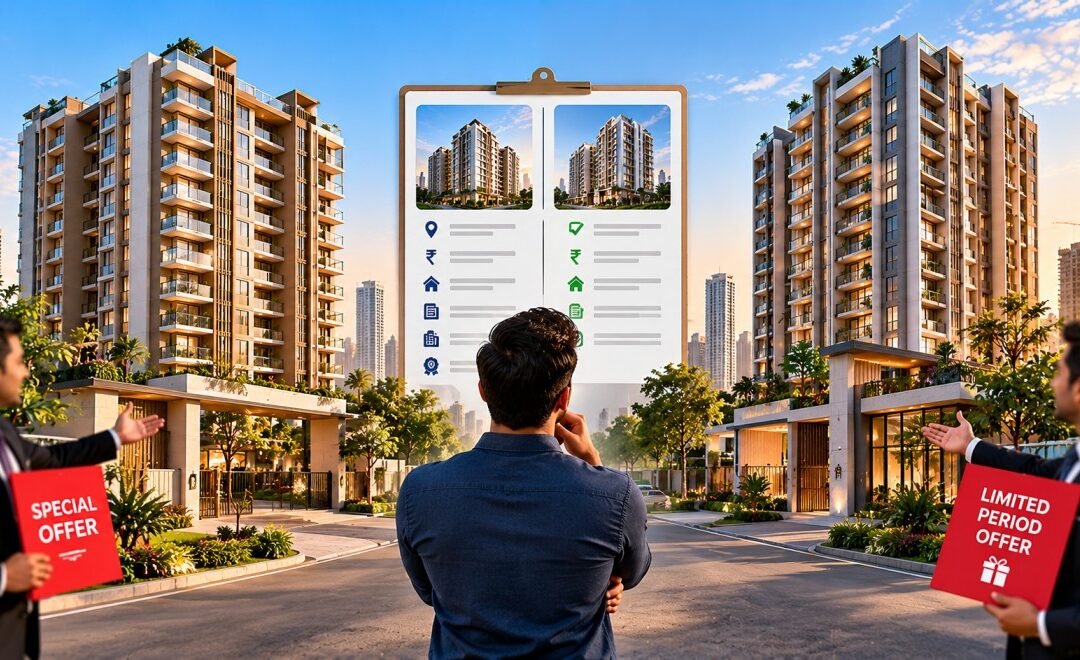
Buying a home is a major financial decision, and comparing two residential projects can become difficult when both developers present attractive offers.
One project may offer a large discount, while another may promote free parking, a modular kitchen, waived charges, flexible payment plans or a limited-period festival offer. These benefits can make one property appear more attractive before you have properly compared the actual homes.
That is why learning how to compare two residential projects is important before making a booking decision.
A residential project should first be evaluated on its own merits. Location, carpet area, construction quality, developer track record, possession timeline, total cost, amenities and long-term suitability should form the foundation of your comparison.
Only after comparing these factors should you evaluate the sales offers.
The key principle is simple:
Compare the property first. Compare the offer second.
Why You Should Compare Residential Projects Without Looking at Offers First
Sales offers can create a perception of urgency and value.
Common property offers include:
- Limited-period discounts
- Free parking
- Free interiors
- Waived charges
- Flexible payment plans
- No-EMI-till-possession schemes
- Clubhouse benefits
- Registration-related benefits
- Festival offers
- Booking bonuses
These offers may have genuine financial value, but they should not become the primary reason for choosing a property.
When you compare two residential projects, first remove all promotional benefits from the equation.
Ask:
If both projects had exactly the same offer, which property would I prefer?
This question helps you understand the actual difference between the two projects.
1. Compare the Location of Both Residential Projects
Location should be one of the first factors in any residential project comparison.

Do not compare only the addresses listed in brochures. Study the surrounding neighborhood and its existing and planned infrastructure.
Compare:
- Distance from your workplace
- Road connectivity
- Public transport
- Schools
- Hospitals
- Shopping facilities
- Restaurants and daily conveniences
- Employment hubs
- Major roads and highways
- Traffic conditions
- Neighborhood development
- Drainage and flooding concerns
- Upcoming infrastructure
For example, Project A may cost ₹5 lakh less than Project B. However, if Project A adds 45 minutes to your daily commute, the lower purchase price may not necessarily make it more suitable for your lifestyle.
When you compare two residential projects, consider both the purchase cost and the everyday cost of living in that location.
2. Compare Carpet Area Instead of Only the Advertised Price
Two projects may both sell a 2 BHK apartment, but that does not mean the homes provide the same usable space.
Compare:
- Carpet area
- Built-up area
- Super built-up area
- Room dimensions
- Balcony size
- Kitchen space
- Storage
- Utility area
- Bathroom layout
- Passage space
A lower-priced apartment may provide considerably less usable space.
For a better residential project comparison, calculate the effective price per carpet area.
Formula
Price per sq. ft. of carpet area = Total property cost ÷ Carpet area
This gives you a more useful comparison than simply comparing the headline price per square foot.
3. Calculate the Total Cost of Both Projects
One of the biggest mistakes buyers make when comparing properties is looking only at the base pric

The actual cost can include:
- Base property price
- Floor-rise charges
- Preferred-location charges
- Parking charges
- Infrastructure charges
- Clubhouse or amenity-related charges
- Maintenance deposits
- Corpus fund
- Registration expenses
- Stamp duty
- Applicable taxes
- Utility connection charges
- Interior expenses
Therefore, when you compare two residential projects, prepare a complete cost sheet for both.
Example
| Cost Component | Project A | Project B |
| Base price | ₹80 lakh | ₹84 lakh |
| Additional charges | ₹8 lakh | ₹5 lakh |
| Registration-related costs | ₹6 lakh | ₹6 lakh |
| Estimated interiors | ₹5 lakh | ₹3 lakh |
| Approx. overall cost | ₹99 lakh | ₹98 lakh |
Project A initially appears cheaper.
But after adding all costs, Project B may actually require a lower overall budget.
This is why total acquisition cost is more important than the advertised property price.
4. Compare the Developer's Track Record
The developer is another important factor when you compare residential projects in India.
Review the developer's previous projects and look for information about:
- Delivery timelines
- Construction quality
- Common-area maintenance
- Amenities
- Post-possession support
- Quality of completed communities
- Transparency in documentation
- Experience with similar projects
If possible, visit a completed project from the same developer.
You can also speak to existing residents about their experience.
A brochure describes what a project is expected to deliver.
A completed project can provide evidence of what the developer has delivered previously.
5. Compare Construction Quality and Specifications
Do not compare two apartments only by their appearance in brochures or sample apartments.
Request the detailed specifications for both projects.

Compare:
- Construction system
- Flooring
- Doors and windows
- Electrical fittings
- Plumbing
- Kitchen specifications
- Bathroom fittings
- Waterproofing
- Wall finishes
- Ceiling height
- Fire-safety systems
- Lifts
- Power backup
- Security systems
Words such as premium, luxury and high-end do not provide enough information for a meaningful comparison.
When you compare two residential projects, ask for specific specifications rather than relying on marketing language.
Before making a final decision, buyers should also understand common construction-related issues and checks.
6. Compare Amenities Based on Your Actual Requirements
More amenities do not automatically mean better value.

One project might offer:
- Multiple swimming pools
- Clubhouse
- Gym
- Sports courts
- Co-working areas
- Party halls
- Children's facilities
- Walking tracks
Another may have fewer amenities but a better location and lower maintenance costs.
Ask yourself:
Which amenities will I actually use?
Also find out how extensive amenities could affect monthly maintenance.
A practical residential project comparison should consider:
Amenities + usefulness + maintenance cost
rather than simply counting the number of facilities.
7. Compare Possession Timelines
Possession is particularly important when comparing under-construction projects.
Check:
- Current construction progress
- Expected possession date
- Project registration details
- Construction milestones
- Payment schedule
- Developer's previous delivery record
If you currently live in a rented property, delays can increase your overall housing cost.
For example:
Monthly rent = ₹30,000
A 12-month delay could mean:
₹30,000 × 12 = ₹3.6 lakh
That is why possession should be part of your financial comparison.
For projects that are under construction, buyers should also understand the regulatory framework that applies to the project.
8. Separate the Property From the Sales Offer
This is one of the most important steps in understanding how to compare two residential projects.
Create two separate sections in your comparison sheet.
| Property Factors | Sales Offer |
| Location | Discount |
| Carpet area | Free interiors |
| Construction quality | Waived charges |
| Developer track record | Free parking |
| Possession | Payment plan |
| Amenities | Booking benefits |
| Total cost | Festival offer |
This prevents the offer from influencing your assessment of the underlying property.
The question should be:
“Which project is better before the offer?”
Then:
“Which offer provides additional value?”
9. Calculate the Actual Value of the Builder's Offer
A builder may advertise an offer as being worth ₹5 lakh or ₹10 lakh.
Do not automatically treat that amount as savings.
Break the offer down.
Ask:
- What exactly is included?
- Is the benefit optional?
- Is it already reflected in the quoted price?
- What is the actual market value?
- Are there additional conditions?
- Does the offer apply to every unit?
- Is there an expiry date?
- Is the offer documented?
- What happens if you do not book immediately?
For example, a package advertised as “₹5 lakh free benefits” may consist of several items whose actual value to you is considerably lower.
The objective is not to reject the offer.
The objective is to determine its real financial value.
10. Do Not Let Sales Pressure Replace Due Diligence
When buyers compare residential projects, they may hear statements such as:
- “Only two units are left.”
- “The price increases tomorrow.”
- “This offer is available only today.”
- “You need to book immediately.”
- “This is the last unit at this price.”
These statements may encourage immediate action.
Instead, request the details in writing.
Take time to compare:
- Cost
- Specifications
- Documentation
- Payment schedule
- Possession
- Cancellation terms
- Offer conditions
A property purchase is a significant financial commitment. A short-term sales deadline should not replace proper comparison and verification.
11. Compare EMI and Financing Requirements
Price is only one part of affordability.
When you compare two residential projects, also compare:
- Down payment
- Loan amount
- Interest rate
- Loan tenure
- Monthly EMI
- Construction-linked payments
- Pre-EMI, where applicable
- Existing EMIs
- Maintenance charges
- Total interest payable
Two apartments with similar prices can result in different cash-flow requirements because their payment schedules may differ.
Before booking, calculate how each project fits into your monthly budget.
12. Consider Your Purpose for Buying
The right comparison depends on why you are purchasing the property.
If You Are Buying a Home
Focus more on:
- Location
- Commute
- Schools
- Hospitals
- Layout
- Construction quality
- Community
- Daily convenience
If You Are Buying for Rental Income
Consider:
- Rental demand
- Tenant profile
- Connectivity
- Nearby employment hubs
- Rental income potential
- Maintenance costs
- Vacancy risk
If You Are Buying for Long-Term Appreciation
Look at:
- Infrastructure development
- Location
- Supply of competing properties
- Developer reputation
- Project quality
- Future connectivity
- Buyer demand
Your objective should influence the weight you give each factor.
Residential Project Comparison Scorecard
A simple scorecard can help you compare both projects consistently.
| Factor | Suggested Weight |
| Location & connectivity | 20% |
| Total acquisition cost | 20% |
| Construction & specifications | 15% |
| Developer track record | 15% |
| Carpet area & layout | 10% |
| Possession timeline | 10% |
| Amenities & maintenance | 5% |
| Rental/resale considerations | 5% |
| Total | 100% |
These percentages are only a framework. You can adjust them according to your requirements.
Importantly, keep sales offers outside the initial scorecard.
Evaluate the property first, and then assess the offer separately.
Questions to Ask Both Sales Teams
To make your comparison of two residential projects more objective, ask both sales teams the same questions.
Price
- What is the complete cost of the apartment?
- What additional charges apply?
- What is included in the quoted price?
Construction
- What specifications are included?
- What is the current construction status?
- What is the expected possession timeline?
Documentation
- What project registrations and approvals are available?
- Can I review the relevant documents before booking?
- What are the cancellation terms?
Maintenance
- What are the expected maintenance charges?
- Are there one-time corpus or maintenance contributions?
Sales Offer
- What exactly does the current offer include?
- What conditions apply?
- Is the offer documented?
- How long is it valid?
Asking both developers the same questions makes your comparison more consistent.
A Simple 24-Hour Process Before Booking
If you are comparing two projects and feeling pressured to make a decision, use this process.
Step 1: Remove the offers
Compare the properties without discounts or freebies.
Step 2: Compare the total cost
Calculate the complete purchase cost for both.
Step 3: Compare the locations
Look at connectivity, infrastructure and everyday convenience.
Step 4: Compare the homes
Check carpet area, layout and specifications.
Step 5: Check the developer
Review completed projects and delivery history.
Step 6: Verify documentation
Review the relevant project and transaction documents before committing.
Step 7: Evaluate the offers
Only now calculate the actual financial value of each promotional benefit.
Step 8: Revisit your priorities
Ask whether the project still fits your requirements without the sales incentive.
Residential Project Comparison Checklist
Before choosing between two projects, check:
- Location
- Connectivity
- Carpet area
- Layout efficiency
- Total acquisition cost
- Construction specifications
- Developer track record
- Possession timeline
- Project documentation
- Maintenance charges
- Financing requirements
- Rental potential, if applicable
- Resale considerations
- Neighborhood development
- Actual value of sales offer
- Offer terms and conditions
This checklist can help you compare two residential projects using the same criteria instead of making a decision based primarily on the sales pitch.
Knowing how to compare two residential projects can help you make a property decision based on the actual value of the homes rather than the attractiveness of a sales campaign.
Start by comparing the location, carpet area, total acquisition cost, construction quality, developer track record, possession timeline, amenities, maintenance and financing requirements.
Then evaluate the promotional offer separately.
A discount, freebie or limited-period benefit may provide additional value, but it should not replace proper property comparison and due diligence.
The offer may change tomorrow.
The location, layout, construction quality and financial commitment of the property you choose can affect you for many years.
The goal of a good residential project comparison is simple:
Understand what you are buying, calculate what you are actually paying, and decide whether the project fits your long-term needs before considering the sales offer.
Frequently Asked Questions
1. How do I compare two residential projects?
To compare two residential projects, evaluate the same factors for both: location, carpet area, total cost, construction quality, developer track record, possession, amenities, maintenance and financing requirements.
2. Should I choose the project offering the biggest discount?
Not necessarily. First compare the properties without considering the promotional offers. Then calculate the actual monetary value of each offer.
3. What is the most important factor when comparing residential projects?
There is no single factor that applies to every buyer. Location, total cost, property size, construction quality, possession and your intended use should all be considered.
4. Why should I compare carpet area?
Carpet area gives you a better understanding of the usable space inside the apartment than simply comparing the advertised super built-up area.
5. How do I calculate the actual value of a builder offer?
Break the offer into individual benefits, identify their actual value, check the conditions attached to them and confirm what is documented.
6. Should amenities influence my project comparison?
Yes, but consider whether you will actually use them and how they may affect ongoing maintenance expenses.
7. How important is the builder's track record?
A developer's completed projects can provide useful information about construction, delivery and post-possession performance.
8. Should possession date affect my decision?
Yes. Delays can potentially increase rent, financing and other carrying costs, depending on your circumstances.
9. How can I avoid being pressured by a property salesperson?
Ask for important information and offers in writing, compare both projects using the same checklist and take adequate time to review the financial and documentation aspects.
10. Should I compare property price or EMI?
Compare both. The property price shows the overall purchase commitment, while EMI shows its impact on your monthly cash flow.
11. How should investors compare two residential projects?
Investors can compare purchase cost, rental demand, potential rental income, maintenance costs, location, competing supply, liquidity and their expected holding period.
12. What is the biggest mistake when comparing two residential projects?
A common mistake is focusing too heavily on the advertised discount while overlooking the property's total cost, location, usable area, construction quality, documentation an