
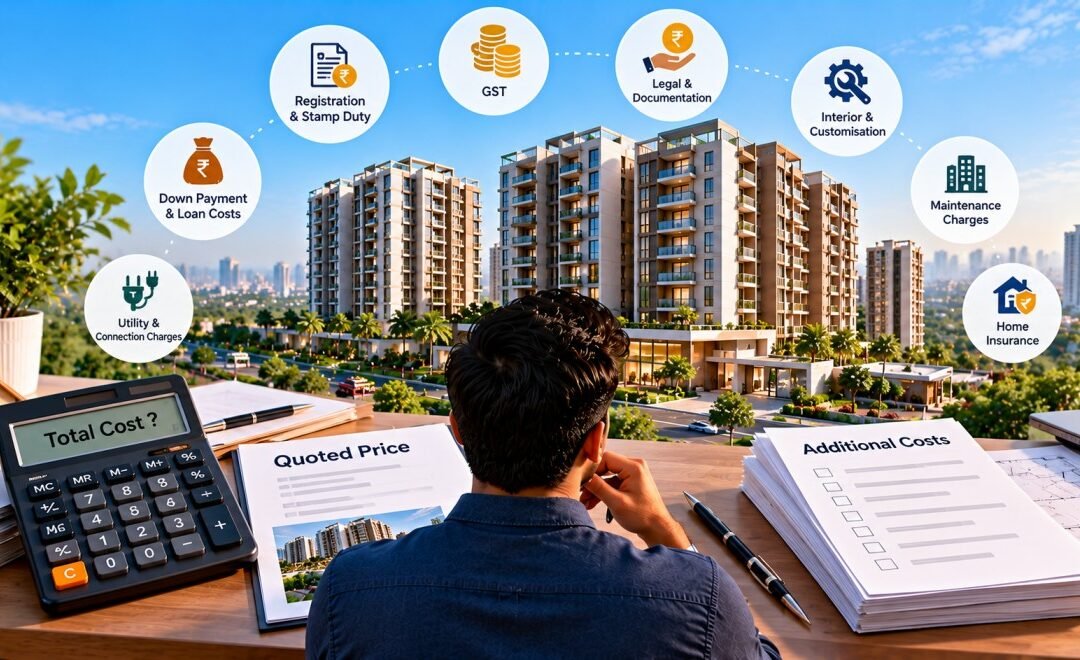
A property advertised at ₹80 lakh does not necessarily mean you need ₹80 lakh to buy it.
The quoted price is often only one part of the total financial commitment. Depending on the property, location, transaction and buyer's requirements, you may also need to account for stamp duty, registration charges, taxes where applicable, parking, maintenance deposits, corpus contributions, legal expenses, interiors, loan-related costs and other charges.
Understanding the property cost beyond the quoted price is therefore essential before deciding whether a home actually fits your budget.
For example, two apartments may both be advertised at ₹80 lakh, but their final purchase budgets can differ considerably after adding all applicable costs.
This is why buyers should calculate the total acquisition cost, rather than making a decision based only on the price displayed in a brochure or sales presentation.
What Is the Quoted Property Price?
The quoted property price is the amount presented by the developer, seller or sales team for the property itself.
Depending on the transaction, it may refer to:
- Base price
- Agreement value
- Price based on carpet area
- Price based on a larger saleable area
- Builder's advertised package price
However, the exact meaning of the quoted price should always be confirmed.
Ask the seller:
“Is this the final amount I need to pay, or are there additional charges?”
This single question can help reveal several components of the property cost beyond quoted price.
Why the Quoted Price Is Not the Complete Property Cost

Consider a hypothetical apartment quoted at:
₹80 lakh
A buyer may initially assume the budget is ₹80 lakh.
But the actual financial requirement could include:
| Cost Component | Example Amount |
| Quoted property price | ₹80 lakh |
| Stamp duty & registration | Varies |
| Parking, if separately chargeable | Varies |
| Maintenance/corpus contributions | Varies |
| Other applicable charges | Varies |
| Interior work | Varies |
| Legal/documentation expenses | Varies |
| Loan-related costs | Varies |
| Actual purchase budget | More than quoted price |
The exact amount depends on the property, state, transaction structure and applicable rules.
Therefore, never assume a percentage and add it blindly. Obtain a written cost sheet from the seller and verify the applicable government charges for your location.
1. Stamp Duty and Registration Charges
Stamp duty and registration are among the most important costs buyers need to consider.

When a property transaction is registered, applicable government duties and registration charges may increase the amount you need to arrange beyond the quoted property price.
The applicable rates can vary depending on:
- State
- Property type
- Transaction value
- Location
- Buyer category
- Applicable government rules
For this reason, buyers should check the current applicable charges for the specific property location rather than relying on a generic percentage found online.
Example
If a property costs ₹80 lakh, even a few percentage points in applicable transaction charges can represent several lakh rupees.
That amount needs to be part of your purchase budget from the beginning.
2. GST and Other Applicable Taxes
Tax treatment can vary depending on the type and stage of the property.
For example, the tax treatment of an under-construction property can differ from that of a completed property, depending on the circumstances and applicable rules.
Before making a booking, ask for a written breakdown showing:
- Whether GST applies
- Applicable GST amount
- Whether the quoted price includes or excludes it
- Any other applicable taxes or statutory charges
Do not assume that a price advertised as a “package” automatically includes every tax.
Understanding the tax component is an important part of calculating the total property cost in India.
3. Parking Charges
Parking is another cost that buyers sometimes overlook.
Depending on the project and transaction, parking arrangements and associated charges can vary.
Ask:
- Is parking included?
- Is one parking space provided?
- Is additional parking available?
- Is the parking charge included in the quoted price?
- What type of parking is being provided?
- Are there separate charges or documentation?
If parking is essential for your household, include the applicable cost in your total property calculation.
4. Maintenance Deposit and Corpus Fund
A new residential project may require buyers to contribute towards maintenance or other common-community funds.
Possible charges may include:
- Advance maintenance
- Corpus fund
- Sinking fund
- Facility-related deposits
- Common-area maintenance contributions
These costs may be collected at different stages.
Ask the developer for a written schedule showing:
What is payable, when it is payable and whether it is refundable or non-refundable.
A seemingly small additional charge can become significant when combined with several other purchase expenses.
5. Preferential Location and Floor-Rise Charges
Some projects may charge additional amounts based on the apartment's location within the building.
For example, additional charges may be associated with:
- Higher floors
- Preferred views
- Corner apartments
- Premium-facing units
- Specific tower locations
Suppose the advertised base price is ₹80 lakh, but the particular unit you want attracts an additional ₹2 lakh in applicable charges.
Your actual property price for that unit is no longer ₹80 lakh.
This is why buyers should compare the final price of the specific apartment, rather than the starting price shown in advertisements.
6. Infrastructure and Other Project Charges
Depending on the project, additional charges may be presented under different descriptions.

These can include items related to:
- Infrastructure
- Amenities
- Utilities
- Electricity connection
- Water connection
- Clubhouse
- Common facilities
- Development-related charges
The terminology can differ between projects.
Instead of trying to determine whether every individual charge is reasonable from its name alone, ask the seller for a complete cost sheet.
Then review each component before signing or paying a booking amount.
7. Legal and Documentation Expenses
Property transactions can involve legal and documentation-related expenses.
Depending on your circumstances, you may spend money on:
- Legal review
- Document verification
- Agreement review
- Property due diligence
- Registration assistance
- Documentation services
These expenses may be relatively small compared with the property price, but they should still be included in your overall buying budget.
If you are buying your first home, it is also useful to understand common mistakes before committing.
8. Home Loan Processing and Financing Costs
If you are financing the purchase through a home loan, your property cost calculation should also consider loan-related expenses.
Depending on the lender and loan structure, these may include:
- Processing fees
- Legal or technical evaluation charges
- Documentation charges
- Insurance-related costs, where applicable
- Other lender-specific fees
The exact charges vary between lenders and loan products.
More importantly, remember that the total cost of buying with a loan is not simply the property price plus processing fees.
You also need to consider the interest paid over the loan tenure.
Example
If you borrow ₹60 lakh for your home, the total amount repaid over several years can be significantly higher than ₹60 lakh because of interest.
Therefore, buyers should calculate both:
Property acquisition cost
and
Total financing cost
9. Interior and Furnishing Costs
This is one of the biggest expenses buyers often forget when calculating their actual budget.
A newly purchased home may require:
- Modular kitchen
- Wardrobes
- Lighting
- Curtains
- Fans
- Appliances
- Furniture
- Storage solutions
- Bathroom accessories
- Electrical modifications
- Decorative work
A home quoted at ₹80 lakh could therefore require a significantly larger overall budget once interiors are included.
The amount depends heavily on the size of the home, specifications and your personal preferences.
Before buying, prepare a separate interior budget rather than treating it as an afterthought.
10. Moving and Setup Costs
The property purchase itself is not the only expense associated with moving into a new home.
You may also need to budget for:
- Moving services
- New furniture
- Appliances
- Internet installation
- Utility connections
- Basic repairs
- Curtains and blinds
- Household setup
These expenses may not form part of the property's legal purchase cost, but they affect how much cash you actually need to move into the home.
For a practical buyer, they should therefore be included in the broader home buying budget.
11. Maintenance After Possession
Your financial commitment does not end when you receive the keys.
A residential property can involve recurring costs such as:
- Monthly maintenance
- Utilities
- Property tax
- Repairs
- Parking-related expenses
- Insurance
- Amenity-related charges
The exact expenses vary according to the property and location.
When comparing two apartments, do not look only at the purchase price.
Also ask:
“What will this property cost me every month after possession?”
This can make a significant difference to long-term affordability.
12. Property Tax and Other Recurring Expenses
Property ownership can involve recurring statutory and household expenses.
Depending on the location and property type, these may include property tax and other local charges.
Ask the seller or relevant local authority about:
- Applicable property tax
- Payment frequency
- Outstanding dues
- Utility charges
- Society or association charges
If you are buying a resale property, outstanding dues should be specifically checked before completing the transaction.
13. Opportunity Cost of the Down Payment
Your down payment is not technically an additional property charge, but it is an important part of your financial planning.
Suppose you purchase an ₹80 lakh home and need ₹20 lakh as your initial contribution.
That ₹20 lakh needs to be available without disrupting your emergency savings or other important financial commitments.
Therefore, when calculating what a property really costs, consider:
- Down payment
- Transaction costs
- Interior budget
- Emergency fund
- Loan-related expenses
- Initial household setup
A property may technically fit your long-term budget but still create excessive short-term cash-flow pressure.
A Complete Property Cost Calculation Example
Let's consider a hypothetical property with a quoted price of ₹80 lakh.
The buyer creates the following preliminary budget:
| Expense | Example |
| Quoted property price | ₹80,00,000 |
| Applicable stamp duty & registration | ₹X |
| Parking, if applicable | ₹X |
| Maintenance/corpus | ₹X |
| Other applicable charges | ₹X |
| Legal/documentation | ₹X |
| Loan-related costs | ₹X |
| Interiors | ₹5,00,000 |
| Moving/setup | ₹1,00,000 |
| Estimated total budget | ₹80 lakh + applicable additional costs |
The important point is that X should be replaced with the actual applicable amount, rather than using a generic assumption.
This approach gives you a more accurate picture of the financial commitment.
Quoted Price vs Total Property Cost
A useful way to think about your purchase is:
Quoted Price
The price advertised or initially communicated for the property
↓
+ Transaction Costs
Stamp duty, registration and applicable taxes
↓
+ Project-Specific Charges
Parking, floor-rise, maintenance, corpus and other applicable charges
↓
+ Financing Costs
Loan processing and interest
↓
+ Home Setup
Interiors, furniture, appliances and moving
↓
= Realistic Home Buying Budget
This broader calculation is much more useful than simply asking:
“How much is the apartment?”
How to Ask a Builder for the Complete Cost Sheet
Before booking, ask the sales team to provide the entire price breakup in writing.
You can ask:
“Please share the complete cost sheet for this specific unit, including the base price, applicable taxes, registration-related costs, parking, maintenance, corpus, floor-rise or location charges, and any other mandatory payments.”
Then ask:
“Are there any other mandatory charges that are not included in this cost sheet?”
Keep the response for your records and compare it against the final agreement.
How to Compare Two Properties by Total Cost
If you are choosing between two apartments, do not compare only their advertised prices.
Create a table like this:
| Cost | Project A | Project B |
| Quoted price | ₹80 lakh | ₹83 lakh |
| Transaction costs | ₹X | ₹X |
| Project charges | ₹X | ₹X |
| Parking | ₹X | ₹X |
| Maintenance/corpus | ₹X | ₹X |
| Estimated interiors | ₹5 lakh | ₹4 lakh |
| Loan-related costs | ₹X | ₹X |
| Estimated total | ₹X | ₹X |
This can reveal that the project with the lower advertised price is not necessarily the one requiring the lower overall budget.
For buyers comparing properties, this is often a more meaningful comparison than simply looking at the headline price.
How Sales Offers Can Distort the Actual Cost
Promotional offers can make a property appear cheaper.
Examples include:
- “₹5 lakh discount”
- “Free parking”
- “Free interiors”
- “No registration charges”
- “Limited-period offer”
- “Cashback”
- “Flexible payment plan”
Before treating an offer as a saving, ask:
- What is the original price?
- Is the benefit already reflected in the quoted price?
- What exactly is free?
- Is there a condition attached?
- Does the benefit apply to your specific unit?
- Is it documented?
- Does it reduce the amount you actually need to pay?
A discount matters only when you understand its impact on the final payable amount.
Build a Property Buying Budget Before You Book
A practical home-buying budget should have at least four sections.
1. Purchase
- Property price
- Applicable taxes
- Stamp duty
- Registration
2. Project Charges
- Parking
- Maintenance
- Corpus
- Infrastructure
- Other applicable charges
3. Financing
- Down payment
- Loan processing
- Interest
- Other lender charges
4. Home Setup
- Interiors
- Furniture
- Appliances
- Moving
- Initial repairs
You can then compare the complete budget with your available savings and expected monthly cash flow.
Property Cost Calculation Checklist
Before booking a property, check whether you have accounted for:
- Quoted property price
- Carpet area and unit specifications
- Stamp duty
- Registration charges
- Applicable taxes
- Parking
- Floor-rise charges
- Preferred-location charges
- Infrastructure charges
- Maintenance deposit
- Corpus contribution
- Utility charges
- Legal/documentation expenses
- Home loan processing costs
- Loan interest
- Interior expenses
- Furniture and appliances
- Moving expenses
- Initial maintenance
- Property tax and recurring costs
This checklist helps you identify the property cost beyond quoted price before committing your savings.
Documents and Costs You Should Verify Before Booking
Before paying a substantial booking amount, verify the relevant property documents and cost details.
Depending on the transaction, this can include:
- Project registration details
- Sale agreement
- Cost sheet
- Payment schedule
- Title-related documents
- Applicable approvals
- Tax details
- Maintenance terms
- Cancellation terms
- Possession details
10 Questions to Ask Before Buying
Before making the final payment or signing an agreement, ask:
- What is the final price of my specific unit?
- Which charges are included in the quoted price?
- Which charges are payable separately?
- What taxes apply?
- What are the registration-related costs?
- Is parking included?
- Are maintenance or corpus charges applicable?
- Are there any future mandatory payments?
- What is the complete payment schedule?
- Is the promotional offer documented in writing?
Getting clear answers can prevent unpleasant surprises later.
The price shown in a property advertisement is only the starting point for your financial calculation.
When you calculate the property cost beyond quoted price, you need to consider applicable transaction charges, taxes, project-specific costs, maintenance, financing, interiors, moving expenses and other costs relevant to your purchase.
The exact amount will vary depending on the property, state, transaction type, developer and buyer's requirements.
The safest approach is to obtain a complete written cost sheet for the specific property, verify applicable government charges and then calculate your total cash requirement.
Instead of asking only:
“Can I afford this ₹80 lakh property?”
ask:
“How much will I actually need to buy, finance, set up and maintain this property?”
That broader calculation can give you a much clearer picture of whether the property genuinely fits your financial plan.
Frequently Asked Questions
1. What is included in the property cost beyond the quoted price?
Depending on the property, additional costs can include stamp duty, registration, applicable taxes, parking, maintenance deposits, corpus contributions, legal expenses, loan costs, interiors and moving expenses.
2. Is the quoted property price the final amount I need to pay?
Not necessarily. Ask the seller for a complete cost sheet showing all applicable charges and taxes for the specific property.
3. What are the biggest hidden costs when buying a home?
Transaction charges, applicable taxes, project-specific charges, interiors, financing costs and recurring maintenance can significantly affect the overall budget.
4. Are stamp duty and registration charges included in the property price?
They may be treated separately depending on the transaction and pricing structure. Confirm the exact treatment with the seller and verify the applicable government charges.
5. Do I need to budget separately for interiors?
Yes. Unless the property is delivered with the interiors you require, prepare a separate budget for the kitchen, wardrobes, furniture, appliances, lighting and other setup expenses.
6. What should I ask the builder about additional charges?
Ask for a complete written cost sheet covering the property price, taxes, registration-related costs, parking, maintenance, corpus, floor-rise charges and any other mandatory payments.
7. How should I calculate the total cost of a property?
Add the quoted property price, applicable transaction and tax costs, project-specific charges, financing costs and estimated home setup expenses to create your overall purchase budget.
8. Can a property offer reduce the total purchase cost?
It can, depending on the terms. However, buyers should calculate the actual monetary benefit and confirm whether the offer applies to their specific unit and is documented.
9. Should loan interest be included in property cost calculations?
For personal financial planning, yes. Loan interest represents a significant part of the total amount you may pay over the loan tenure, even though it is a financing cost rather than part of the property's quoted price.
10. Why is the total property cost more important than the base price?
The total property cost shows the broader financial commitment required to purchase and set up the home. It can provide a more realistic basis for deciding whether the property fits your budget.
11. Can two properties with the same quoted price have different total costs?
Yes. Differences in parking, project charges, maintenance, interiors, taxes, financing and other expenses can result in different overall budgets.
12. When should I calculate the complete property cost?
Ideally, calculate it before paying a substantial booking amount. Getting the complete cost sheet early gives you an opportunity to assess affordability before making a major financial commitment.